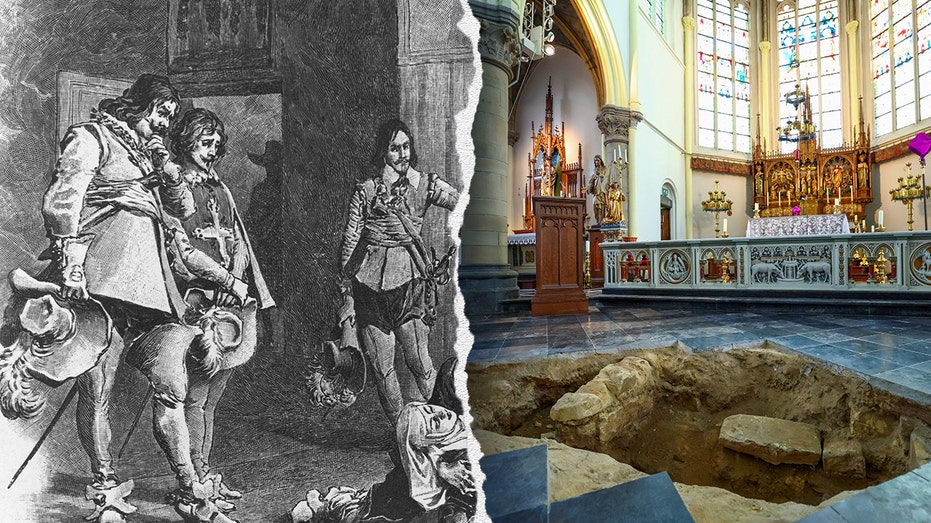
The investigation into the possible remains of the legendary Fourth Musketeer has hit a major snag. Months after the initial discovery, local officials have revealed that improper archaeological work may have compromised the evidence.
The remains, which may belong to Charles de Batz de Castelmore d'Artagnan, were found near the altar of St. Peter and Paul Church in Maastricht, Netherlands, in February. D'Artagnan is the legendary French musketeer who inspired Alexandre Dumas' "The Three Musketeers." He died during a siege near Maastricht on June 25, 1673.
Contemporary documents suggest that d'Artagnan was buried on consecrated ground nearby, making the altar discovery especially promising. However, on July 2, the Municipality announced that the initial excavation work was not properly documented, resulting in the loss of significant archaeological information.
When archaeologists began the official excavation on March 13, only about 50% of the skeleton remained in its original position, and roughly a third of the skeleton's skull was missing. The situation is highly complex due to the improper documentation of the initial excavation work, which included the collection of various bones without documentation.
A retired archaeologist, who led the initial excavation work, was arrested in May after refusing to surrender the bones to authorities. Officials stated that it is unclear whether the skeleton belongs to d'Artagnan or not, citing inconsistent findings from isotope analysis that suggest the man's diet consisted of 27% to 30% fish, which is inconsistent with what is known about d'Artagnan's lifestyle and diet.
Although officials stressed that the research does not rule out the possibility that the skeleton belonged to d'Artagnan, they noted that the current data makes identification as d'Artagnan less likely, although it cannot be ruled out entirely.