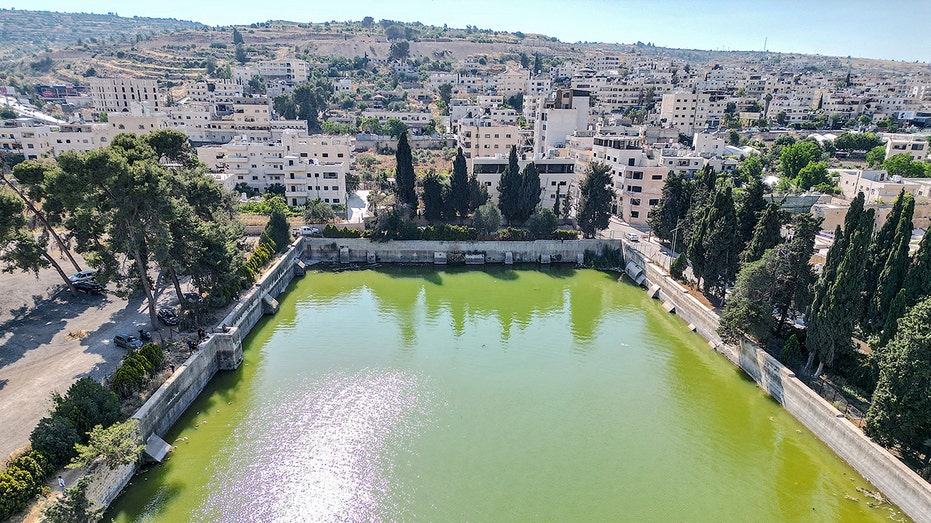
The ancient Solomon's Pools, a collection of three reservoirs built over 2,000 years ago to supply Jerusalem with water, have become a focal point in a modern political dispute between Israel and the Palestinian Authority.
The reservoirs, located between the towns of Efrat and Bethlehem, south of Israel's capital, were constructed during the Hasmonean period in the second century B.C. Herod the Great later expanded the system to provide water to his palace-fortress at Herodium.
The pools hold approximately 288,000 cubic meters of water, or more than 10 million cubic feet, and are fed by the Arrub and el-Biyar aqueducts, which, together with rainwater, historically supplied Jerusalem with water year-round.
The Israeli town of Efrat has accused the Palestinian Authority of allowing the historic site to deteriorate since it was placed under Ramallah's jurisdiction following the 1993 Oslo Accords.
Efrat Mayor Dovi Shefler stated that the pools are not only significant for Jewish history but also for Judeo-Christian history, and that preserving the site is essential for exercising sovereignty and sustaining tourism in the area.
The pools have undergone significant changes since the Oslo Accords. Under the agreements, the West Bank was divided into Areas A, B, and C. Solomon's Pools are located in Area A, which falls under Palestinian civil and security control.
However, during the negotiations, then-Prime Minister Yitzhak Rabin maintained that the pools would remain under Israeli control. The reservoirs themselves ultimately mistakenly fell inside Area A, leading to neglect and deterioration.
Yonatan Marcus, chief of staff of the Efrat Municipality, stated that under the Palestinian Authority's control, things have changed for the worse. The pools are now filled with sewage water, and signs in Arabic prohibit swimming due to contamination.
Marcus added that the sewage contamination was not natural, with wastewater deliberately diverted into the pools, replacing the fresh water that flowed there until the Oslo Accords. He said this occurred despite the PLO's commitment under the agreement to protect historical sites in Area A.
Despite the deterioration, visits by Israeli officials, including Finance Minister Bezalel Smotrich, have prompted improvements. The Palestinian Authority removed about 200 bags of garbage from the site following years of neglect.
Ahmad Fattouh, a spokesman for Palestinian Authority President Mahmoud Abbas's Fatah faction, rejected the allegations, stating that Israeli locals diverted the springs that feed the pools and that the Palestinian Authority has restored the site and developed it as a tourist destination.
Fattouh also accused Israeli officials of using the issue to justify taking control of the site, saying Smotrich's visit showed that the pools were not completely dry, contrary to claims by Efrat officials.
International spokesman for Hebron, Yishai Fleisher, described the pools as akin to rediscovering a lost part of the Jewish Temple, as they supplied Jerusalem with water for some 2,000 years. He called for a radical change in policy, stating that the pools should be placed under Israeli control in Area C.
Fleisher claimed that the Palestinian Authority's goal is to stop Israeli presence in Judea and Samaria and the Land of Israel, and that they are not interested in developing the site for its own sake.