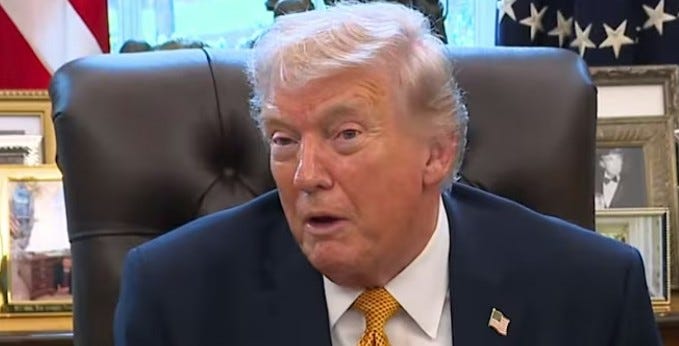
President Donald Trump delivered a primetime address from the White House on July 16, 2026, focused on U.S. election security. During the speech, he announced the declassification of intelligence documents and made a series of allegations involving China, the 2020 election, and a subsequent effort by intelligence officials to withhold information from him and from Congress.
Trump stated that his claims are supported by classified and newly released documents, though much of the underlying material had already been documented in publicly available intelligence community reports. He described a multiyear effort by China to compromise U.S. election data beginning in the 2020 cycle.
According to the president, declassified records show China obtained 220 million voter files through what he called the largest compromise of election data in history. The stolen data included names, addresses, phone numbers, party affiliations, and other registration details, with a dedicated exploitation unit assigned to the operation.

Trump alleged that the intelligence community concealed the scope of the breach from him as president. He claimed agencies learned in 2020 that voter data in 18 states had been bought, stolen, or hacked by China but withheld the information rather than reporting it.
The cover-up allegation is partly supported by Senate Judiciary Committee records. Released FBI emails show the Bureau recalled an Albany Field Office report alleging China produced fraudulent driver's licenses to manufacture mail-in votes in 2020.
An FBI analyst wrote that the report was pulled because it would contradict then-Director Christopher Wray's testimony before the Senate. Wray had told lawmakers days earlier that the FBI had not seen any coordinated national voter fraud effort.
A later FBI review found no indication the Bureau's China task force pursued the lead despite corroborating intergovernmental reporting and logical investigative avenues. The characterization of 2020 as the most secure election in American history is difficult to reconcile with sweeping changes to voting procedures that year.
A record 43% of votes nationwide were cast by mail in 2020, roughly double the historical rate and the highest share in U.S. history. The Census Bureau found that 69% of voters cast ballots nontraditionally, either by mail or before Election Day.
Drop box use expanded to unprecedented scale, growing from eight states with explicit statutes before 2020 to roughly 40 states by Election Day. Forty-one percent of mail voters returned ballots via drop boxes rather than by mail or to election officials.
Ballot receipt deadlines were extended beyond Election Day in multiple states through last-minute court rulings. Pennsylvania allowed three extra days, North Carolina nine, and Michigan up to two weeks for ballots to arrive.
Each of these shifts departed from prior practice within the same cycle, forming the basis for describing the 2020 election as procedurally novel rather than more secure than earlier contests. Beijing's influence efforts against Trump predate the 2020 cycle.
CIA reporting cited in the speech indicates that by mid-2018, the Chinese Communist Party directed all available elements opposed to the president to reduce his votes and prevent reelection. The same reporting found China targeted both the 2018 midterms and the 2020 presidential election.
By mid-2019, Beijing's strategy shifted toward undermining domestic confidence in the president. A declassified December 2023 National Intelligence Council assessment found China tacitly approved efforts to influence a handful of 2022 midterm races involving both parties.
The assessment stated PRC leaders issued broad directives to intensify influence operations since 2020 and identified specific members of Congress to punish or reward based on their stance toward Beijing. PRC actors conducted activities to undermine or promote candidates from both major parties.
One documented operation used inauthentic accounts to covertly denigrate a named U.S. senator online, a finding backed by a Justice Department indictment, FBI information, and private-sector reporting. The intelligence community assigned high confidence to that assessment.
A Senate bill introduced in November 2024 cites a February 2024 threat assessment stating China aims to sow doubts about U.S. leadership and extend its influence. The legislation was referred to the Foreign Relations Committee and has not advanced.
Trump also alleged, citing CIA reporting, that China sought to use contacts inside major U.S. companies to turn business leaders against him and pay journalists for negative coverage. These specific claims have not been independently corroborated in declassified documents.
The president said FBI intelligence gathered in 2020 included allegations of Chinese attempts to manufacture illegal ballots, withheld by what he termed rogue bureaucrats. He cited an email in which an analyst admitted to deliberately massaging the presidential daily briefing to omit China-related election information.
A declassified March 2021 intelligence community assessment lends partial support, recording a Minority View that China took at least some steps to undermine Trump's reelection via social media and official statements. The same assessment found Russian cyber operations compromised U.S. state and local networks and exfiltrated voter data in 2020.
A separate assessment found U.S. adversaries including Russia, China, Iran, and North Korea possess the capability to compromise election infrastructure. Voter registration databases and centralized data systems were identified as the most vulnerable to exploitation.
Citing that material, Trump said his administration is now notifying the states whose data was compromised by China, along with many others.