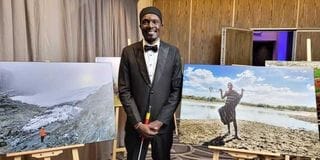
The ice has been retreating for years, but on that day in Uganda's Rwenzori Mountains, it was the silence that struck Peter Kuloba the most. A mountain ranger stopped in his tracks and stared at the cracked glacier before him. For nearly three minutes, he said nothing. Standing a few metres away, Kuloba lifted his camera.
"I was compelled to take that shot," he recalled. "I wanted it to become a reference."
The image became more than a landscape photograph. It was a record of a place in transition.
"Maybe five years from now, when I return and there is no glacier," he said, "at least I will have something to show my children and the world."
For 41-year-old Ugandan photographer, the moment reinforced his belief that photography can document environmental change.
Known as Tera, Kuloba has spent nearly two decades moving between villages, forests, mountains and national parks, photographing cultures, traditions, wildlife and landscapes.
But his travels have also exposed him to another side of Africa. Forests are disappearing. Wetlands are being degraded. Plastic waste is accumulating in communities and waterways. Climate change is altering landscapes and putting pressure on people whose lives depend directly on nature.
Increasingly, these changes have found their way into his photographs.
"It is a story I never intended to tell," he said. "Photography began simply as curiosity."
He started photography with a basic film camera given to him by his sister. With no batteries, it relied on available light, sparking his interest in photography. Later, while pursuing computer studies, Kuloba spent time at his cousin's photography studio. His passion deepened after acquiring his first DSLR camera in 2008.
"My passion for photography changed when I owned my first DSLR," he said. "I shot and experimented as much as I could, and I am still doing so."
Without formal training, he learnt through practice. Every assignment, road trip and mistake became part of his education.
"My journey has really been one about grinding and grinding," he said.
Today, he is a freelance photojournalist covers environmental conservation, climate change, culture, health and commercial assignments. His love of travel has been central to that journey.
In 2013, he travelled to capture a solar eclipse in Uganda, one of the first major journeys he made with his own equipment.
He became interested in remote communities, pastoralists, cultural traditions and people whose lives remain closely tied to forests, wetlands, rivers and wildlife. The farther he travelled, the more he noticed how quickly those environments were changing.
"In nature, there are the beautiful sides," he said. "But there are also the bad sides caused by human behaviour."
The Rwenzori photograph became one of the clearest examples of that shift. For Kuloba, the most powerful part of the photograph was not simply the glacier, but the reaction of the ranger who stood before it.
"He was disturbed," Kuloba recalled. "He just stood there looking at it."
The image later earned him a Gold Award at the Safal Eye in the Wild Photography Competition.
But the award was secondary to the reason he took the photograph.
"If I come back in five years and the glacier is gone," he said, "at least there will be something that shows what was here."
Across his journeys, Kuloba has encountered other landscapes under pressure from human activity and climate change. He has seen forests cleared, wetlands degraded and plastic waste accumulate. For him, photography can bridge the gap between scientific knowledge and public understanding.
Climate reports may document rising temperatures, disappearing ice and changing rainfall patterns, but many people may never read them.
A photograph, he believes, can communicate the reality of change almost instantly. But getting those photographs is rarely easy.
One of his biggest challenges is mobility. Environmental stories often unfold far from Kampala, sometimes in places that require hours of travel over difficult roads. By the time information reaches him, the opportunity to document an event may already be disappearing.
Reaching remote communities requires transport, accommodation and sometimes several days on the ground. For a freelancer, that can mean financing assignments personally.
Security also limits his work, particularly in parts of northeastern Uganda, where movement after dark may not be possible. His work has taken him to Kenya, Rwanda and South Sudan, although most of his photography remains rooted in Uganda.
Kenya has also influenced his development. He attended photography workshops there and drew inspiration from photographers such as Mutua Matheka and Sebastian Wanzala.
"I admire his versatility and refusal to be confined to a single photographic genre," he said.
Now, Kuloba wants to expand his work across borders and document environmental and cultural stories that connect East Africa.