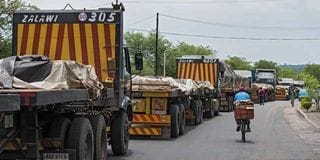
The East African Community’s Council of Ministers convenes this month to assess 27 outstanding trade barriers after the June 30, 2026 deadline set by Heads of State in March elapsed with no resolution, a scenario blamed on inconsistent national enforcement, protectionist domestic policies, and persistent bilateral disputes.
Council chairperson Rebecca Kadaga, who is Uganda’s EAC Affairs minister, this week acknowledged that non-tariff barriers continue to undermine regional trade, increase the cost of doing business, prohibit free movement of goods and services, “which is the crux of the EAC Common Market Protocol.” “So, we are convening in the first week of August in Arusha. We want to see what has happened after the deadline,” the minister told The EastAfrican.
From 2023 up to June 2026, the EAC reported 27 NTBs. Tanzania accounted for 14, Kenya five, Rwanda three, DRC three, Uganda one, and Burundi one. “We had the deadline fixed by the Heads of State of June 30th and we are using this month (July) to evaluate impact throughout. At the end of this month we are going to evaluate the impact in partner states to see how many Partner states have complied, and whether they have complied or not (with the deadline),” Ms Kadaga said.
Data from the EAC Secretariat shows that intra-EAC trade reached $4.8 billion in the third quarter of 2025, up 15 percent from the same period in 2024.
Despite this expansion, it still accounts for roughly 15 percent of the bloc’s total trade. By contrast, trade with the rest of Africa reached $10.1 billion, or 32.2 percent of the total, suggesting that the region’s trade flows remain more outward-oriented than focused on the East African common market.
Most of the outstanding NTBs are on discriminatory charges, fees and levies by partner states, non-preferential treatment of goods originating from partner states, non-recognition of calibration certificates from partner states and requirement for upfront payment of guaranteed cheques for storage of oil and penalties after expiry of grace period.
Read:East Africa can end trade barriers if it shares the blame
Adrian Njau, policy adviser at the East African Business Council, the business community expected the NTBs, especially those related to discriminatory taxes, to be resolved through tax reform under Finance Acts during National Budget process for 2026/27 financial year, but partner states maintain discriminatory taxes.
Transporters have cited too many roadblocks on the Northern and Central corridors, with the stretch between Nemule on the Uganda-South Sudan border and Juba being notorious – with about 100.
Kenya’s Principal Secretary at the EAC ministry, Dr Caroline Karugu, while speaking at the East Africa Logistics, Warehousing & E-Commerce Conference and Expo hosted by the Nation Media Group in Nairobi, decried the high number of roadblocks on regional highways. “The Northern Corridor handles 35 million tonnes annually but faces challenges, which include 22 to 27 police checkpoints,” she said.
She decried the un-gazetted roadblocks and arbitrary police stops that result in extortion, noting that they are significantly raising transit costs along major freight corridors. “When a police officer flags you down to have a conversation with you about your work, or you are going to Burundi, that conversation is estimated to cost at least Ksh13,000 ($100) per stop,” the PS said. “It is something that I am working on to ensure that the Northern Corridor becomes a corridor that yields efficiency.”
The agricultural and agri-food sectors are often disrupted by administrative and regulatory bottlenecks between member states.
For instance, from 2024, Kenya’s Kajiado County has been charging transit fees of Ksh2,000 ($15.46) per foreign truck entering through the Namanga-Kenya-Tanzania border.
Rwanda is charging un-harmonised flat rates for vehicles transiting through the Rwanda borders. This is against the agreed principle of distance x weight for transit vehicles. Uganda is upholding the principle of distance and weight. A $100 fee is charged on Rwandan nationals crossing into Tanzania more than three times a month. This was identified by the Central Corridor Team during a survey from Rusumo to Dar es Salaam port.
Kenya charges a discriminatory excise duty of 10 percent on fish from Uganda. This means fish from Uganda is being treated as an import, which is against the Customs Union Protocol. Kenya further charges an additional five percent levy on fish.
The Tanzania Dairy Board is imposing a 1.75 percent Free on Board value charge on Kenyan dairy produce. This levy applies to pasteurised whole milk, skimmed milk, condensed milk, yoghurt, ice cream, and powdered milk renders Kenyan goods uncompetitive.
Rwanda has introduced a 39 percent excise duty on juice products manufactured in Kenya and transferred into Rwanda. Uganda is subjecting Kenya manufactured furniture to excise duty of 20 percent.
Although EAC partner states have agreed to uniformly apply the EAC Common External Tariff (EAC-CET) with minimal stay of applications and duty remissions, differences remain in domestic tax regimes due to the lack of harmonisation of domestic taxes.
Consequently, partner states continue to adopt varying tax measures to address their national fiscal and economic priorities.