You have to wonder sometimes when watching a modern streaming release whether the people behind the camera are working to create a worthwhile experience or simply collecting a paycheck. It is a cynical take, sure, but it is hard not to think that when the final product feels profoundly half-baked.
You sit there watching a movie and get that feeling that things could have been different, a bit more creative — that someone, at some point, should have stepped in to elevate the material.
That feeling hangs over72 Hours, a picture I was looking forward to, hoping to enjoy it given its line-up in front of and behind the scenes.
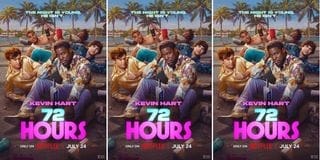
Released in 2026,72 Hoursis an R-rated American comedy directed by Tim Story and written by Jon Hurwitz, Hayden Schlossberg, Kevin Burrows, and Matt Mider.
The premise is serviceable, even promising, a 40-year-old advertising executive, desperate to salvage a flailing career, finds himself swept into a chaotic Miami bachelor weekend after being mistakenly added to a group chat of twentysomethings.
It is a premise built for generational friction, the setup practically writes its own tension between a man in the early stage of a midlife crisis, fighting for relevance and a cohort of digital natives who have never known anything else.
The cast features Kevin Hart headlining alongside Marcello Hernández, Mason Gooding, Kam Patterson, Ben Marshall, Zach Cherry, Michael Mando, Mike Epps, and Teyana Taylor, with a surprise cameo.
On paper, that is a robust roster. Behind the scenes, the project has four screenwriters and nine producers, keep in mind this is a streaming film. Yet, despite that heavy artillery, the end product feels like a substandard direct-to-DVD B-movie shot on a modest production budget.
There are isolated random funny spots where you will find yourself laughing out loud, and a few sequences involving a pink limousine will have you invested.
The overarching premise of bringing a disparate group together across various locations has foundational potential. Unfortunately, everything else feels clunky. The comedic timing frequently misfires, leaving scenes and moments feeling dead, and you get the impression the dialogue is only saved from total ruin by the survival instincts of the younger performers.
The younger actors manage to outshine the headliner. Kam Patterson and Marcello Hernández deliver fantastic performances that inject actual energy into their scenes. Ben Marshall feels the most relaxed and natural of the bunch, moving through his role with an effortless ease.
Mason Gooding is decent enough, though you can catch the gears turning as he works through his lines. Michael Mando plays a gangster with a generic touch that lacks drive and agency, making him feel like a cardboard cut-out lifted straight out of a standard crime caper.
Kevin Hart. There is a recurring issue with Hart in films like this, stemming from how he functions as a comedic actor. Look back at his best work, Central Intelligence with Dwayne Johnson, Ride Along with Ice Cube, or Get Hard with Will Ferrell.
In those movies, Hart always had another big star to bounce his frantic energy against. That dynamic created a natural balance, forcing him to play off a strong counterpart.
Without that anchoring presence here, Hart is left front and centre, and he appears acutely conscious of his status. His performance feels stiff rather than grounded. You can watch him gear up to hit a punchline or transition into a persona, stripping away authenticity. He comes across as someone who simply memorised his lines that morning and phoned them in.
Compounding these performance issues is the visual presentation. The cinematography is poor even for a Netflix movie, plagued by flat framing and a general lack of aesthetic ambition. Certain shots look distinctly cheap, carrying a visual texture associated with low-budget productions, complete with questionable lighting choices. During the third-act showdown between the gang and the antagonist, there is a wide shot featuring a background that looks glaringly artificial, carrying the unmistakable aesthetic of a cheap CGI backdrop or green screen composite. It looks bafflingly unpolished for a high-profile streaming release.
Despite having four credited screenwriters, this feels like it was conceptualised and written by AI, the script leans heavily on the lowest-hanging fruit imaginable- that is, tired generational stereotypes pitting Gen Z against Millennials. Instead of developing sharp observations from a creative angle, the writers dredge up every overexposed cliché seen across social media feeds. The tropes are then forced into the narrative purely to drive the plot forward or set up predictable payoffs, resulting in uninspired interactions that feel hollow and uneven. Even the main gangster's backstory involving his father feels shoehorned in just to check off narrative boxes. 72 Hoursat its core, based on the team behind and in front of the camera, is a terrible movie. Between the limp direction, poor cinematography, uninspired script, and Hart's strained performance, it stands as a creatively bankrupt and uninspired experience. It serves as an unfortunate reminder of how disposable modern streaming productions can feel when effort takes a backseat to corporate content churn.