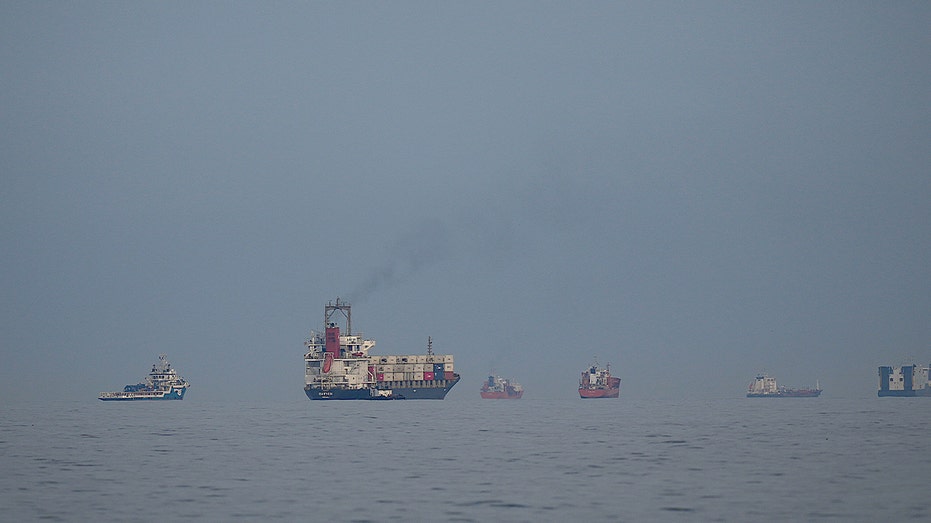
In July, Iran's threat to close the Strait of Hormuz highlighted the vulnerability of global commercial infrastructure, but the strait had already ceased functioning as a reliable chokepoint prior to the conflict.
Since the conflict began, more than 1,100 vessels experienced GPS and AIS interference in a single day, with ships appearing on tracking systems at airports or deep inside Iranian territory, and crews navigating the Strait of Hormuz by radar alone due to satellite navigation issues.
America relies on a second, invisible chokepoint: the Global Positioning System (GPS), which timestamps every credit card swipe and equity trade, synchronizes the power grid and cellular networks, and guides combines through fields, container ships into port, and infantry through contested terrain.
However, the faint signal engineered in the 1970s has become the backbone of modern society, carrying the weight of the entire global economy and our military edge. Global aviation logged roughly 430,000 jamming and spoofing incidents in 2024, a sharp 62% increase in a single year.
A basic jammer can be built from off-the-shelf parts for a few hundred dollars, making it a readily available tool for adversaries. The vulnerability of GPS is not a matter of engineering oversight, but rather physics: a satellite in medium Earth orbit broadcasting at limited power will always produce a faint signal at the receiver, which can be easily overpowered by a nearby jammer.
China has recognized this weakness and is rapidly expanding its next-generation navigation satellites, including low Earth orbit (LEO) constellations that operate closer to Earth, broadcast far stronger signals, and are designed with electronic warfare in mind.
Beijing aims to dominate the navigation layer of the 21st-century economy, and Congress has noted this shift, stating that the United States is falling behind China in satellite navigation.
The solution does not lie in another slow government program, but rather in emerging from American commercial industry. U.S. companies have designed and launched navigation satellites in domestic factories using private capital, which operate in LEO and deliver signals up to 100 times stronger than GPS.
These systems resist spoofing by design, provide centimeter-level accuracy, and work with the GPS receivers already installed in millions of aircraft, vehicles, vessels, and weapons. A software update is often all it takes to transition equipment America already owns to navigation that can survive attacks.
The Space Force has taken note of this and canceled plans for a government-owned "Resilient GPS (R-GPS)" constellation in favor of leveraging commercial services. The fiscal year 2027 defense bill now advancing in the House would require the Air Force to demonstrate capabilities with commercial LEO providers.
Funding what Congress has already directed, procuring operational services, and establishing minimum resilience requirements for legacy GPS would be the next steps in turning congressional direction into deployed capability.
America has wagered that a constellation of navigation satellites would transform warfare and the global economy, and that wager succeeded beyond any planner's dreams. However, it also taught our adversaries precisely what to hold at risk. The next era of navigation will belong to the first nation to focus on fielding resilient capabilities.
American industry has already placed resilient navigation capabilities in orbit, and whether the U.S. government moves at the speed of relevance will determine if America retains the decisive advantage it has held for 50 years – or cedes it to another power.