In Mozambique’s northeast region, an expansive ruby mine has long been a source of government revenue. It has also been a source of headaches for policymakers.
It sold some five million carats, earning about $6 million—nearly a fifth of the overall revenue from mining.
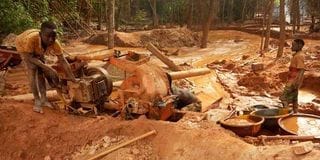
The mines are mostly run by a licensed major operator. But they also support some 60,000 artisanal miners. The government at one point considered most of these miners to be illegal and cracked down on them. However, many were not criminals. They were people who grew up in local communities and earned a living sifting through soil to extract rubies for sale.
How could the government bring the locals into the formal mining sector while keeping the mining firm happy? This dilemma was not isolated, and the example formed part of discussions as experts gathered in Accra, Ghana, this week for a high-level conference on critical minerals and governance.
Fatima Mimbire, a project director and extractive industry researcher from Mozambique, explained that the country, like most others across the continent, had regarded artisanal miners as illegal. “But after research, we presented the facts, and that is changing. Many of them are members of communities where these resources are found but are not integrated into the mining economy. The state always focused on big mining companies, excluding the local people,” she told The EastAfrican in an interview on the sidelines of the Regional High-Level Conference on Governance, Critical Minerals and Conflict in Africa, organised by the Open Society Foundations.
The three-day forum called on African governments to approach critical minerals by placing democratic governance, accountability, industrialisation, peacebuilding and citizen participation at the centre of the continent’s response to growing global demand for strategic mineral re-sources.
In Mozambique, the lack of inclusion is partly blamed for the rise of extremist groups that have forced thousands from their homes and sometimes attack mines.
Fatima says Mozambican communities have traditionally practised artisanal mining to survive, long before global firms arrived in their areas.
But it is not that the government has ignored the plight of locals. In fact, a special licence had been created for local small-scale miners, although it had never been implemented.
In turn, the lack of structured engagement with artisanal miners has fuelled illegal dealing, including smuggling. “They are not paying taxes because they are marginalised. No one takes them into account. They are just surviving,” she explained. “For me, the problem is the promise and expectation of quick money that big companies can pay upfront. But this informality is costing the government a lot of money in revenue. In informal trading, they find buyers who pay less than they should. “That is why some foreigners are fuelling that informality because they know they can pay less.”
She offered lessons, however, on how Mozambique is reversing the trend: It has allowed informal miners to create associations that engage directly with authorities, register small firms, and train members on their rights and obligations. “They are now able to explain that they are small-scale miners, not criminals. They are training their members, looking for partners, and formalising their operations. “The locals have also organised themselves into groups and scheduled the sale of their minerals on specific days so they do not have to compete. We can prevent conflicts between formal mining companies and artisanal miners. The state should incentivise the associations and implement programmes to introduce new technology to them.”
Mozambique may be dealing with this, but artisanal miners have struggled to shake off the criminal label across the continent, according to experts who discussed the policy shifts needed to ease tensions between local communities and governments.
One of the problems is that while most mines are located in rural areas, local communities are often simply told to relocate and allow the mining firms to take over. Sometimes they resist; other times they are forcibly removed. The result is long-term resentment. “If you look at most of Africa’s critical minerals today, they are all in rural communities. Most of these rural communities that have these critical minerals are also places where there are issues of conflict and civil war,” said Dr Chukwuemeka B. Eze, Director of Democratic Futures in Africa (DFA) at Open Society Foundations, based in Dakar, Senegal.
Conflict, he said, pushes people out of their homes, leaving room for illegal mining and under-mining transparency. “These are governance questions. If the government cannot manage mineral resources, if it cannot distribute wealth or involve local communities in decisions on how to manage critical minerals, it increases the propensity for conflict. Lack of transparency is responsible for some of the poverty that we see in Africa today, as well as some of the conflict,” he told The EastAfrican.
With conflict, everybody tries to profit from the mines, but the government is unable to collect enough revenue. Stakeholders from the Democratic Republic of Congo, one of the world’s most mineral-rich countries, say they have experienced the problem of illegal mining for decades. “Many times, mining companies lie to the public,” said Patient Matabishi, Civil Society Coordinator in the Democratic Republic of Congo and leader of the NGO, Dynamic Community for Social Cohesion and Development (DYCOD-RDC). “They promise to build roads or schools but vanish after extracting the minerals. We need a strong link between communities and governments to ensure leaders listen to the public,” he explained. “If you go to a village that has minerals, you will often find that it has no roads or other infra-structure to serve the people. The people feel marginalised. Unfortunately, outsiders take ad-vantage of that and drive a wedge between communities to profit from it.”
In the Congo, conflict is both a cause and an effect of poor governance in the mining sector, especially the marginalisation of artisanal miners.
Mr Matabishi explained that in some mining areas, communities have had to pick up arms to protect their resources, making it harder for authorities to govern. In other places, people picked up arms because they were incentivised to join the looting or were funded by outsiders to do so. “The local people are not stupid, even if they may not have gone to school or are old,” he argued. “They know what they want. If the government signs contracts with mining companies, it is very important that it speaks with the people and properly explains what is happening. Many times, this doesn’t happen.”
As of 2026, current UN data show that nearly a third of the world’s critical mineral reserves, including cobalt, copper, lithium, manganese, nickel, graphite, bauxite (aluminium), platinum and other rare earth minerals, are found across the Democratic Republic of Congo (DRC), Tanzania, South Africa, Zambia, Guinea, Mali, Morocco and other African countries.
That means Africa’s role in the global energy transition, including the production of electric vehicle batteries, hydrogen power technologies, electronics and electric vehicles, is becoming increasingly important.
Africa’s minerals are also seen as essential to major global powers. Washington, in its National Security Strategy, has framed African critical minerals as essential to diversifying supply chains away from China, securing resources for clean energy and advanced manufacturing, and deepening partnerships through investment, infrastructure and diplomatic agreements. It has identified corridors such as the Lobito Corridor in Angola, and bilateral frameworks with mineral-rich African states as part of that strategy.
The biggest challenge, however, lies in how countries involve local communities and govern their mineral wealth.
Dennis Mwinkpeng, a Resource Economist at Open Society Foundations, suggested that artisanal miners sometimes produce more minerals than formal companies in countries such as Ghana and Zimbabwe. “We have underestimated the potential of this sector for a very long time. For instance, in Ghana, more than 50 percent of gold production in 2025 came from small-scale miners. It is not that there are no big companies in Ghana, but the output of these small-scale producers is significant,” Mr Mwinkpeng explained. “A large portion of the supply chain rests with local artisanal miners. With big mining companies, very little benefit goes to communities. With small-scale miners, whatever they earn, they rein-vest in the local community, whether through procuring goods and services or supporting related businesses.
It all depends on how African governments view artisanal miners and respond to their needs.