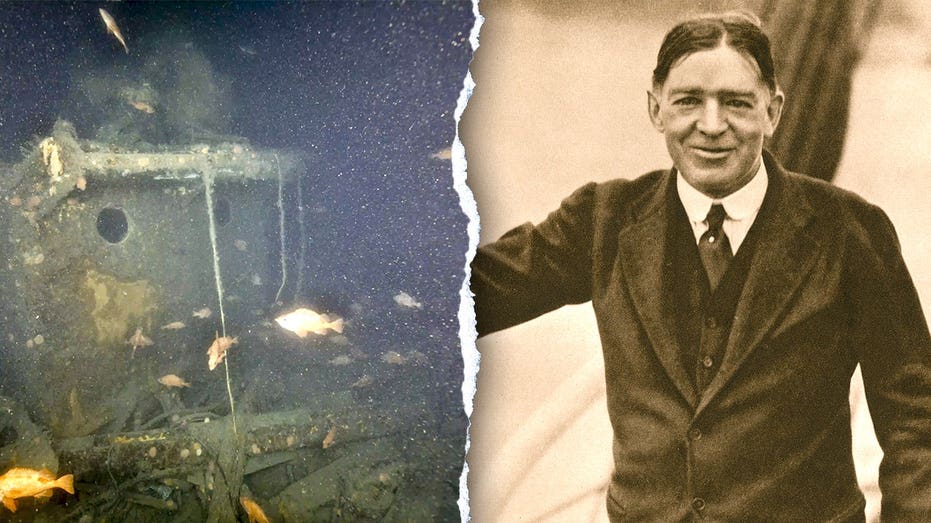
Officials released the first close‑up images of Quest, the final ship of Antarctic explorer Sir Ernest Shackleton, captured at its wreck site in the Labrador Sea, about 1,280 feet deep off Newfoundland and Labrador, Canada. The images were made public in July.
After six decades underwater, the hull remains recognizable; the co‑chief scientist at Woods Hole Oceanographic Institution noted that the bow, stern, rudder and propeller are still discernible despite net coverage. The ship’s basic shape is unmistakable.
The wreck is encrusted with pink corals and hosts several fish species, including cod, redfish and wolffish. Visible fishing nets drape across the superstructure, while some metal portholes remain intact.
Shackleton died aboard Quest in 1922 at age 47 after a heart attack while the vessel was anchored at South Georgia. The ship later changed ownership, operated in Arctic waters, and sank in the Labrador Sea in 1962 after being crushed by ice floes.
A senior official of the Royal Canadian Geographical Society described the sight of the historic vessel as a moving experience, emphasizing the sudden emergence of the bow from darkness. The observation underscored the ship’s enduring presence.
The expedition employed the Falcon remotely operated vehicle and the deep‑submergence vehicle Alvin to capture high‑resolution footage and construct a digital twin of the wreck, supported by the National Science Foundation. These tools enabled detailed three‑dimensional mapping.
The scientist leading the digital‑twin effort expressed surprise at the extent of fishing gear and the vibrant marine ecosystem surrounding the wreck, noting that the area was richer in life than anticipated. The unexpected biodiversity highlighted the site’s ecological significance.
While metal components remain relatively intact, wooden elements such as the deck have largely collapsed and are deteriorating rapidly after decades of exposure. The wooden structure is now in an advanced state of decay.
Researchers plan to preserve the site through detailed digital mapping rather than artifact recovery, arguing that the existing data already provides a comprehensive historical record. This approach minimizes disturbance of the wreck.
The project highlights the dual value of historic shipwrecks as both cultural artifacts and artificial reefs that support diverse deep‑sea communities, offering insights into marine biology and maritime history. Public engagement aims to deepen appreciation for both history and the ocean.
The release follows a recent study that reexamined the loss of Shackleton’s earlier expedition ship, suggesting structural weaknesses contributed to its sinking alongside ice damage. The new perspective reshapes understanding of that historic tragedy.