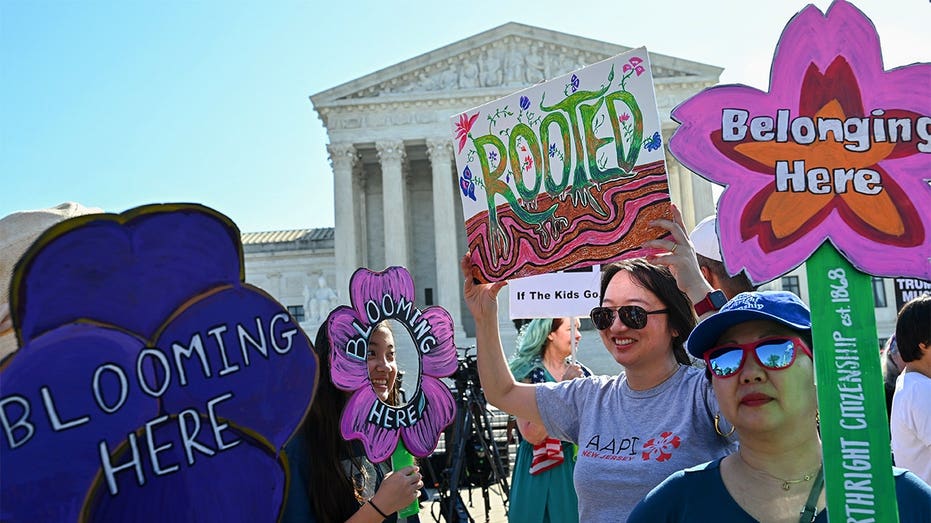
The Supreme Court's recent decision on birthright citizenship has opened up a new front in the fight over the issue, shifting the focus to the U.S. territories. Rep. Morgan Griffith, R-Va., has introduced a bill, the End Birthright Citizenship for Territories Act, in response to the 'Barbara' decision.
The bill aims to address concerns about "birth tourism" in the territories, where children born to non-citizen parents can automatically access U.S. citizenship. Griffith argues that Congress has the authority to revise the birthright citizenship laws in the territories, established by federal statute.
Four of the five U.S. territories – the U.S. Virgin Islands, Puerto Rico, Guam, and the Northern Mariana Islands – would be covered by the bill, with American Samoa excluded. Griffith claims that the bill would stop the "so-called 'birth tourism' that is taking place in the American territories."
Griffith's proposal relies partly on the Insular Cases, a group of early-20th-century Supreme Court decisions addressing how constitutional protections apply in U.S. territories. Critics argue that the bill targets the wrong people, noting that people admitted to the Northern Mariana Islands under federal oversight should be subject to strengthened enforcement.
Del. Kimberlyn King-Hinds, R-CNMI, has expressed concerns about the bill, stating that it singles out Americans living in the territory. King-Hinds believes that Congress should strengthen enforcement rather than adjusting rights granted to people born in the territory. She also notes that the Northern Mariana Islands have a unique relationship with the mainland through the "Covenant," a negotiated agreement that deserves careful consideration.
The Supreme Court's decision in United States v. Vaello Madero has raised questions about the authority of Congress over citizenship rules in the territories. Justice Neil Gorsuch's separate opinion has potentially set up another court battle, should Griffith's bill gain further steam.
Critics argue that if territorial residents want full rights, they should pursue statehood, as Alaska and Hawaii did in the modern era. However, Griffith's proposal could force Congress and the courts to confront how much authority lawmakers retain over citizenship rules in the territories.