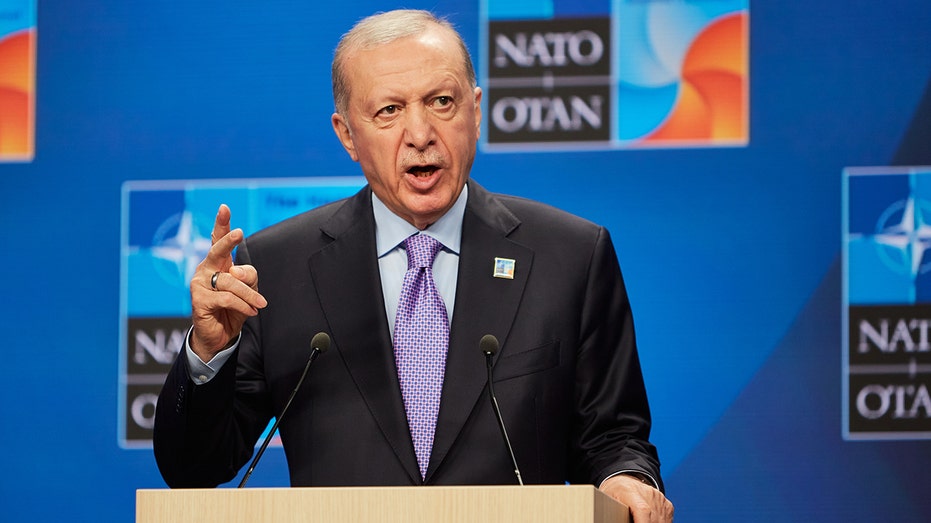
Turkey's president, Recep Tayyip Erdoğan, has undergone significant transformations in his leadership style over the years, shifting from a focus on Islamism to embracing Turkish nationalism and building alliances with hardline nationalist parties.
According to experts, Erdoğan's foreign policy has consistently reflected political calculation more than religious doctrine, with anti-Israel sentiment cutting across ideological lines in Turkey.
As Turkey's economy slowed and regional ambitions faltered, Erdoğan pivoted once again, embracing Turkish nationalism and cultivating the image of an indispensable strongman capable of restoring Turkey's historical influence.
Supporters credit Erdoğan with transforming Turkey into a regional power, with an estimated 35% of the population backing him. Some supporters depend on government assistance and patronage networks built under his rule, while others believe Erdoğan restored dignity to conservative religious Turks who long felt marginalized by the country's secular establishment.
However, critics say the price of Erdoğan's loyal political base has been Turkey's democratic institutions, with authorities increasingly using courts and criminal investigations to sideline political opponents.
After years of anti-Western rhetoric and disputes with Washington, Turkey has worked to repair relations with the United States and Europe, with Erdoğan's shift in posture coming as Turkey's strategic importance has grown dramatically.
Turkey controls the Bosporus and Dardanelles, fields NATO's second-largest military, and plays a critical role in the Black Sea following Russia's invasion of Ukraine.
Experts argue that Erdoğan's latest embrace of NATO is simply another example of his political flexibility, with some viewing his increasingly assertive foreign policy as proof Turkey has reclaimed its place on the world stage.
However, Human Rights Watch argues that Erdoğan has used Turkey's growing importance to NATO as political cover while expanding pressure on journalists, activists, and opposition figures.
Freedom House says Erdoğan has become "increasingly authoritarian" over the past decade, consolidating power through constitutional changes and the imprisonment of political opponents, independent journalists, and civil society figures.
Turkey's prisons held more than 420,000 inmates, far exceeding their official capacity of roughly 304,000, according to a recent report.
NATO allies have grown quieter on Turkey's rights record as Ankara's strategic value has risen, with some experts believing Erdoğan's domestic agenda can be understood through a single principle: "Everything is designed to keep him in power."
As Trump heads to Turkey, Erdoğan's leadership style may be a key factor in understanding one of NATO's most consequential and unpredictable leaders.