Silicon Labs has unveiled BG2B, a Bluetooth Low Energy system-on-chip designed to be the company's lowest-power Bluetooth LE SoC to date. The device targets the complex design trade-off between battery life, security, and integration that often occurs at the endpoint level in IoT devices.
The announcement matters for IoT device makers as it addresses the critical engineering choices that happen far below the cloud platform. A sensor, tag, remote control, or connected peripheral may be judged in the market by its application experience, but its commercial viability can depend on a few board-level decisions: radio power consumption, security architecture, component count, and integration work the OEM must absorb.
Silicon Labs is positioning the BG2B as an endpoint SoC for designs where the wireless component must do more than provide connectivity. This is distinct from typical Bluetooth LE announcements, which often focus on protocol support or incremental radio performance. Instead, BG2B reduces the power burden of Bluetooth LE while keeping security and integration within the SoC discussion.
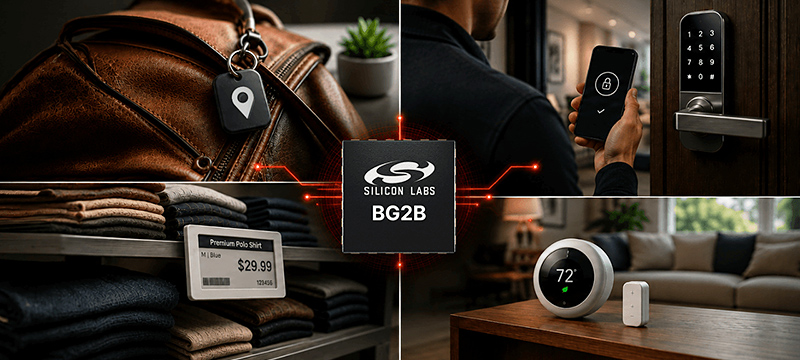
For OEMs, a Bluetooth LE SoC is a different proposition from a ready-made wireless module. A module can simplify RF integration and certification work, but a SoC gives product teams more control over board layout, bill of materials, and form factor, requiring deeper hardware and RF engineering. BG2B's announcement speaks directly to device makers that want to optimize the endpoint itself rather than buy connectivity as a module.
The practical implication is that BG2B will be evaluated by engineering teams not only on Bluetooth LE functionality but on whether its power, security, and integration profile fits the mechanical and energy constraints of the product. Lower radio and system power can affect maintenance intervals, battery sizing, and enclosure design in battery-powered IoT devices.
Security is also becoming harder to separate from low-power design, especially in IoT devices that frequently sit at the edge of broader architectures. Improvements elsewhere in the architecture do not compensate if the endpoint becomes the weak link. Silicon Labs' decision to pair the BG2B power message with security positioning reflects this reality.
Bluetooth LE remains a key technology for local IoT connectivity even in deployments that ultimately depend on cellular, Wi-Fi, Ethernet, or LPWAN backhaul. Endpoint power consumption has a direct effect on service cost, as battery replacement and device access can dominate the lifetime economics of a deployment.
For system integrators, BG2B could become relevant where the customer requirement is not merely to connect a device but to fit connectivity into tight space, power, and security constraints. Enterprises and industrial players will be less concerned with the SoC brand itself than with whether devices based on it can reduce maintenance overhead while meeting internal security expectations.
While detailed performance numbers and package information for BG2B are not available, the direction of the announcement is clear: Bluetooth LE component selection is increasingly being shaped by complete endpoint economics, not just wireless protocol support. BG2B enters this discussion as Silicon Labs' lowest-power Bluetooth LE SoC, with security and integration presented as part of the same design equation.


