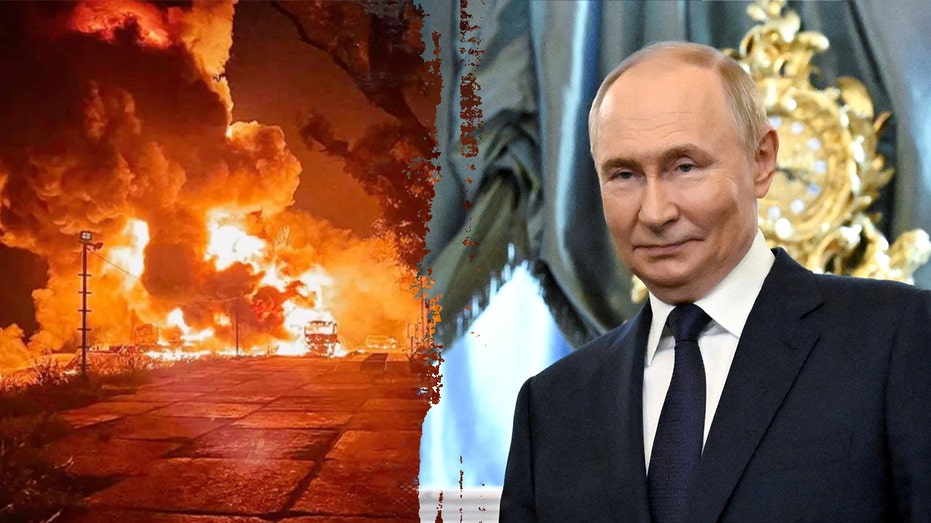
The killing of a Russian military figure in a Moscow suburb marked the second time in less than a year that a blast has torn through the city, leaving a high-ranking officer dead. On June 9, explosives planted under a BMW detonated as the driver began leaving a parking lot, killing Lt. Gen. Damir Davydov, a Russian Defense Ministry official responsible for supplying missiles and artillery ammunition to Russian forces fighting in Ukraine.
The location of the explosion was striking, occurring roughly 1,150 feet from the site where Lt. Gen. Yaroslav Moskalik, deputy chief of the Main Operations Directorate of Russia's General Staff, was killed in a car bombing in April 2025. Months prior, another senior Russian officer was assassinated in Moscow, when Lt. Gen. Igor Kirillov, the head of Russia’s nuclear, biological and chemical protection troops, was killed when a bomb hidden in an electric scooter exploded outside an apartment building.
A string of high-profile killings has targeted senior Russian military figures since Russia launched its full-scale invasion of Ukraine in February 2022. At least 15 Russian generals have been killed, including five lieutenant generals, seven major generals, and three former generals. The toll includes a mix of operational losses and psychological blows to the Russian army, with some generals dying in Ukraine and others within Russia or in Russian-controlled territory.
The deaths have fueled internal tensions between Russia’s military and the FSB, Russia’s powerful domestic security service and successor to the Soviet KGB. A European intelligence source said the security services have long held a privileged position over the armed forces, while the military has long occupied a vulnerable position inside the Russian power structure.
A Russian opposition figure, Maxim Katz, said the Kremlin historically has feared popular military figures because the army is one of the few institutions with the capacity to challenge political power. Katz argued that even during wartime, when the military might be expected to gain status, Putin’s system keeps the army politically weak, with generals often viewed as a threat.
The apparent compromise, according to the European intelligence source, was to shift responsibility away from the FSB. The source said the security service of the Russian presidential administration would take care of those generals, but Katz noted that the FSB is a much bigger threat to generals than the Ukrainian army, with the security service putting generals in prison faster than the Ukrainian army kills them.
The internal pressure on Putin may also collide with Russia’s parliamentary elections in September, which Katz believes Western observers are largely ignoring. He said the vote will not be free, and the Kremlin is expected to manipulate the results, but if public support for Putin’s United Russia party has fallen sharply, it may become harder for the regime to make the official results appear believable.