The African Union says it is backing candidates seeking international positions including the two vying for the post of the United Nations Secretary-General, even though it remains cagey on endorsement.
Mahmoud Ali Youssouf, the Chairperson of the African Union Commission, urged AU members to support candidates seeking elections to the various international institutions.
It came as Uganda’s latest entrant Olara Otunnu divided opinion at the UN Security Council, the definitive organ that could determine who becomes the 10th Secretary-General of the UN.
On Thursday, UN straw polls, informally used to gauge the popularity of candidates, revealed a Council mostly undecided on Otunnu’s entry.
It showed that 8 out of 15 members of the Council had ‘no opinion’ on whether he should run. Two members ‘encouraged’ his contest while five said they would ‘discourage.’ Otunnu himself incidentally invented straw polls in the 1980s to break a tie between contenders for secretary-general. The system has been used since then where members of the Council cast coloured secret ballots to indicate whether they ‘encourage’, ‘discourage’ or have ‘no opinion’ any candidate.
Usually, the results of these polls are kept confidential, but are sometimes leaked to influence public opinion.
Otunnu entered the race last week, just five days before the first straw poll session. On the continent, he is competing against former Senegalese President Macky Sall who had six ‘encourage’ and seven ‘discourage’ votes, according to a leaked tally. Two members had no opinion. Five other candidates are in the race, which had been seen as an opportunity for a woman to become secretary-general for the first time, probably from the Latin America and Caribbean regions.
This is why the African Union may struggle with its own candidates.
However, the AU has been clear about other contests for international positions.
They include former AU Commissioner Josefa Sacko, now Angolan Ambassador to Italy. She is contesting for Food and Agriculture Organization (FAO) Director-General. Others are Justice Njoki Ndung’u of Kenya, who is seeking to be a judge of the International Criminal Court alongside Veronic Wright of the Gambia, Ezéchiel Amani Cirimwami of the Democratic Republic of Congo, Evelyn Ankumah of Ghana, Tujilane Chizumila of Malawi, Rosette Muzigo Morrison of Uganda, Deo John Nangela of Tanzania.
Kenya’s Prof Phoebe Okowa is also seeking to be re-elected on the International Court of Justice bench.
The African Union has stayed clear of endorsing UN Secretary-General candidates, but was expected to discuss a general endorsement for contenders for the ICC and other positions.
Macky Sall was unable to secure the AU's support for his candidacy, as Africa had initially backed the idea of the Caribbean or Latin American region presenting a candidate. Olara Otunnu entered the race late, and although most diplomats consider him qualified, they believe that the tradition of regional rotation, whereby regions allow others to bid, should be upheld.
Most members of the East African Community, with the exception of Burundi, which nominated Sall, already support Otunnu’s bid. However, they have not made their support public.
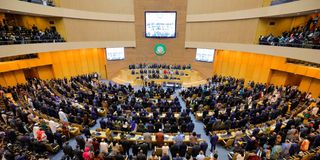
According to diplomats who spoke toThe EastAfrican, the African Union is faced with the dilemma of appearing to alienate one candidate while also betraying a region that most countries had agreed to back. “African candidatures to international positions will be presented to this August body,” said Youssouf in his opening remarks during the Forty Ninth (49th) Ordinary Session of the Executive Council of the African Union Member States being held in Addis Ababa. “I would like all of us to go before these international institutions by demonstrating and showing unity and solidarity with each other.”
The African Union traditionally floats names of candidates to contest for international positions and ministers of foreign affairs often have a say on who to endorse. Prof Okowa and Ms Sacko were endorsed for their respective bids.
Kenya’s Prime Cabinet Secretary and Cabinet Secretary for Foreign and Diaspora Affairs Musalia Mudavadi said African contenders have already shown their ability to lead. “The growing success of African candidates in international elections demonstrates the power of unity, early coordination and collective action,” said Mudavadi. “Kenya commends the African Union Commission and the Committee Secretariat for strengthening this continental process, which is helping secure greater African representation and influence in global institutions for the benefit of present and future generations.”
Mudavadi, nonetheless, campaigned for Prof Okowa and Lady Justice Ndung’u.
However, by failing to back one candidate for the UN or even dissuading them from running, the continental body now risks a defiance that could embarrass it, should any of the candidates end up winning the seat and succeed António Guterres. A regional endorsement offers basic support, but it is not a legal requirement. Candidates must be nominated by at least one UN member state.
In a letter addressed to the President of the UN General Assembly and the UN Security Council on July 24, Uganda's Permanent Representative to the UN, Adonia Ayebare, announced Uganda's nomination of Otunnu for the position of UN Secretary-General.
Mr Otunnu's candidacy will increase the list of candidates to succeed Gutteres to seven.
In 1996, no formal Otunnu candidacy ever reached the ballot for the UNSG post because no member state submitted his nomination, although he expressed intent to compete at the time.
At the time, Otunnu was President of the International Peace Academy in New York and had already served as Uganda’s permanent representative to the UN and President of the Security Council.
Chile's Michelle Bachelet, Ecuador's Maria Fernanda Espinosa, Rafael Grossi of Argentina, Costa Rican Rebeca Grynspan, and Guyana's Carolyn Rodrigues-Birkett are the other UNSG candidates, all in the running to succeed outgoing Secretary-General Guterres.