Soracom has announced the commercial availability of its SGP.32‑compatible IoT eSIMs and the Connectivity Hypervisor orchestration capability, transitioning the offering from pre‑order to purchase.
The launch targets IoT fleets that require remote SIM profile control across multiple regions, operators, and extended device lifecycles.
Modern connected products increasingly treat the SIM as a lifecycle management component rather than merely a connectivity element, as devices are often manufactured in one country, activated in another, and moved across borders during service.
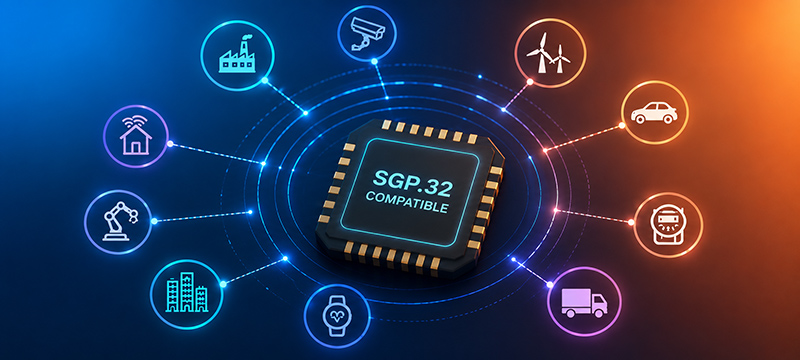
The SGP.32 standard addresses this reality by supporting headless IoT devices that lack screens or local user interfaces, allowing enterprises to manage active profiles remotely.
Unlike earlier standards such as SGP.02, which centered on automotive use cases with operator‑driven provisioning, and SGP.22, which assumed user interfaces, SGP.32 enables profile control without direct device interaction.
Soracom’s solution pairs SGP.32‑compatible eSIMs, available in both card and chip form factors, with a Connectivity Hypervisor that leverages the SGP.32 IoT Manager to add, remove, and switch multiple operator profiles on remote SIMs.
The platform is built on standard eUICC, eIM and SM‑DP+ components and can work with third‑party mobile network operator profiles.
What distinguishes this release is its emphasis on orchestration: an API and console allow administrators to manage multiple profiles and link provisioning to automation rules based on deployment region, regulatory requirements, or application needs.
Although SGP.32 simplifies remote provisioning, enterprises still require a control layer for policy enforcement, activation, profile switching and exception handling; a built‑in fallback to a Soracom profile ensures continuous connectivity when a target profile is unavailable.
The approach enables manufacturers to produce a single hardware SKU and later assign appropriate connectivity profiles in the field, shifting the decision point from production planning to operational management.
Future versions of the Connectivity Hypervisor aim to provide unified management of connections from multiple operators through a single control plane, pending integration of operator profiles for resale on the platform.
For original equipment manufacturers, the primary benefit is SKU simplification and the ability to ship devices before finalizing connectivity arrangements, which is valuable for international distribution.
Enterprises and industrial users can treat connectivity profiles as managed assets, automating switches in response to geographic, regulatory, or application changes.
System integrators may reduce custom provisioning effort by leveraging the API‑driven model when deploying devices across diverse markets.
Mobile operators must integrate their profiles to expose lifecycle management, usage monitoring, and fleet management features, making interoperability a critical factor.
The commercial release reflects a broader industry shift, moving remote SIM provisioning from telecom back‑office functions into the enterprise IoT operations stack and offering device owners greater flexibility for managing long‑lived, unattended fleets.


