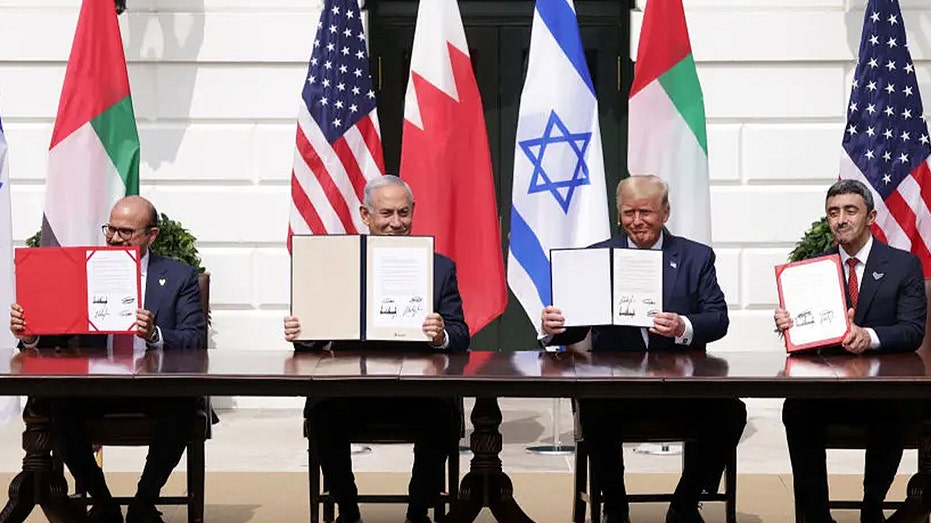
President Donald Trump predicted in recent days that additional countries would soon join the Abraham Accords, renewing debate over whether Israel is becoming increasingly isolated or continuing to expand its most important strategic relationships.
"The Abraham Accords have been, I think, a tremendous success," Trump said during a Tuesday Oval Office meeting with Lebanese President Joseph Aoun. "I think you’re going to see a lot of countries joining pretty soon."
Trump's prediction underscores a central debate about Israel's global position: Public support for the country has fallen sharply in the United States and across much of the world, yet Israel continues to build or preserve diplomatic, military, energy and technology relationships with foreign governments.
The Abraham Accords, brokered by the Trump administration in 2020, normalized relations between Israel and the United Arab Emirates, Bahrain, Morocco and Sunday. Trump has made expanding the agreements a central goal of his Middle East strategy.
The dispute depends partly on how isolation is measured. Critics point to worsening public opinion, pressure at international institutions and growing opposition among Democrats and younger voters. Israeli officials and conservative foreign-policy experts argue that government-to-government cooperation remains strong and, in some regions, is expanding.
Trump reinforced that strategy Thursday by saying a U.S. civilian nuclear agreement with Saudi Arabia would depend on the kingdom joining the Abraham Accords. The statement showed the administration attempting to use one of Washington’s most valuable offers to Riyadh to secure normalization with Israel, but it did not demonstrate that Saudi Arabia had agreed to do so.
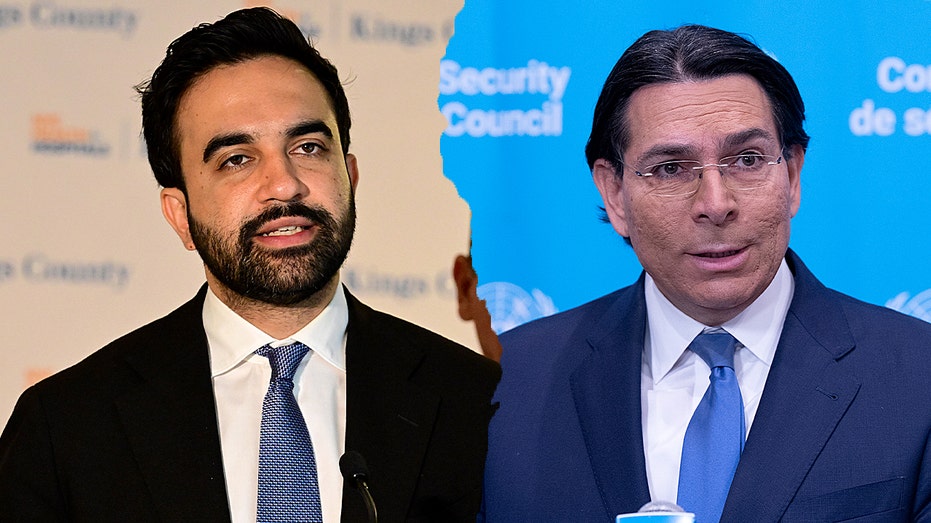
Israeli Ambassador to the United Nations Danny Danon rejected the contention that Israel had become isolated.
"The claim that Israel is an isolated country is simply not true," Danon told Fox News Digital. "While the campaign to dismantle the Hamas terrorist organization has drawn international criticism, Israel’s relationships with other countries have not weakened. They have evolved."
Former White House national security official Richard Goldberg similarly argued that Israel retains strong support among conservatives and that its electoral gains are translating into closer government relations.
"Polling in the United States shows massive support among conservatives and Republicans, including self-described MAGA, for Israel still," Goldberg told Fox News Digital. "And that’s reflected around the world, particularly among conservative candidates and parties that win elected office right now."
Goldberg pointed to political changes in Latin America, expanding partnerships in the Eastern Mediterranean and Israel’s continuing defense and technology relationships as evidence that public criticism has not translated into comprehensive strategic isolation.
The dispute comes amid polling that shows Israel retaining deep support among Republicans while losing ground across the broader American electorate and much of the world.
Eighty percent of self-identified MAGA Republicans said Israel’s security matters to U.S. security and prosperity, a Reagan Institute survey released in June found, while 73% supported sending Israel U.S. weapons. Among MAGA Republicans under 30, 63% said Israel’s security matters to the United States and 60% supported sending weapons.
The same survey found that broader support was narrowing. Sixty-five percent of Americans said Israel’s security matters to U.S. security and prosperity, down six percentage points from a year earlier.
The figure fell nine points among Democrats to 57%, compared with 75% of Republicans and 80% of MAGA Republicans.
A Pew Research Center survey published in June found that a median of 67% of adults across 36 countries viewed Israel unfavorably, while 25% viewed it favorably. The findings came from Pew’s Spring 2026 Global Attitudes Survey.
In the United States, 60% of adults viewed Israel unfavorably, up from 53% in 2025 and 42% in 2022, according to a separate Pew survey conducted March 23 to March 29. Eighty percent of Democrats and Democratic-leaning independents held an unfavorable view, while negative assessments were also widespread among adults under 50.
Israel no longer held a statistically significant advantage over the Palestinians in Americans’ sympathies, in February. Forty-one percent said they sympathized more with the Palestinians and 36% with the Israelis, although Gallup said the five-point difference was not statistically significant.
In 2023, 54% sympathized more with Israelis and 31% with Palestinians.
Former Chicago Mayor Rahm Emanuel highlighted that erosion during a July 8 speech at Tel Aviv University.
"Support for Israel around the world is declining," Emanuel said, "The only diplomatic achievement Israel has secured in the past three years is Somaliland."
Emanuel’s conclusion focuses on Israel’s declining public legitimacy and its strained position in traditional diplomatic institutions. Goldberg and Danon argue that it overlooks expanding government-to-government relationships built around defense, intelligence, energy, technology and trade.
Goldberg pointed in particular to Latin America, where he said newly elected conservative governments have made closer ties with Israel an early priority.
"Every time a government in South America right now flips from left wing to right wing, one of the first things they do is reestablish better relations with Israel, withdraw recognition of a Palestinian state and see what else they can do to make Israel a strategic partner," Goldberg said.
He cited Argentina under President Javier Milei and the proposed "Isaac Accords," along with political changes in Chile, Colombia and Bolivia, as evidence of a broader realignment.
Goldberg also argued that Israel remains central to emerging partnerships involving energy, defense, intelligence and critical infrastructure.
"If you’re in the Eastern Mediterranean and you’re Greece and you are Cyprus, you’re thinking about how do we work with Israel to make the Eastern Mediterranean partnership even stronger," he said. "If you’re Armenia and Azerbaijan in a tough neighborhood between Turkey and Iran, you’re talking to Israel, you’re getting closer to Israel."
Israel, Greece and Cyprus reaffirmed their strategic partnership during a trilateral summit in December 2025, agreeing to expand cooperation in energy, security, emergency preparedness and regional connectivity.
Danon said the diplomatic shift is visible even inside the United Nations, an institution where Israel routinely faces critical resolutions and public condemnation.
"We see this every day in the corridors of the United Nations," he said. "While many South American countries were once highly critical of Israel in recent years, we are now cooperating with many of them. These discussions are happening in public and behind the scenes."
"As Israel’s official representative to the United Nations, I regularly meet with ambassadors from around the world, including from Arab countries, to quietly advance initiatives where we share common interests," Danon said.
Danon went further than Goldberg in assessing Israel’s position since the Oct. 7, 2023, Hamas terrorist attacks and the subsequent war.
"Compared to the period before October 7th, Israel is in a far stronger geostrategic position," Danon said. "That is reflected not only in regional developments but also in the country’s diplomatic relationships around the world."
The competing evidence suggests that much of the disagreement depends on how isolation is defined.
Israel may be losing public support and influence in traditional international institutions while simultaneously preserving or expanding government-to-government cooperation in defense, technology, intelligence, energy and agriculture.
Goldberg acknowledged that relationships driven by conservative political victories could become vulnerable when governments change.
But he argued that Israel is increasingly building relationships around durable national interests rather than political ideology alone.
The central risk for Israel is that today’s collapse in public opinion could eventually reshape tomorrow’s government policies. Conservative governments may currently protect and expand strategic ties, but younger voters and left-wing parties could alter those relationships after future elections.
Israel is scheduled to hold national elections Oct. 27, the country’s first since the Oct. 7, 2023, attacks.
Goldberg argued that a change in Israel’s government would provide a test of whether international opposition is directed primarily at Prime Minister Benjamin Netanyahu or at Israel itself.
"If there is somebody else who becomes prime minister next, we will have to evaluate," Goldberg said. "Those very loud detractors of Israel who right now use Netanyahu as their symbol for bashing and say it’s not about Israel, it’s about Netanyahu, they’ll be put to the test very quickly."
He noted that the boycott movement and anti-Israel campus organizations remained active during the previous government led by Naftali Bennett and Yair Lapid, when Netanyahu was not prime minister.
"Is their hatred and venom really just about Bibi Netanyahu, or is it fundamentally about a Jewish state that they don’t like existing?" Goldberg asked.
For now, both realities appear to be unfolding at once: Israel remains a sought-after military, intelligence and technology partner for a growing group of governments, while its support among the global public has fallen to levels that could eventually threaten those relationships.