
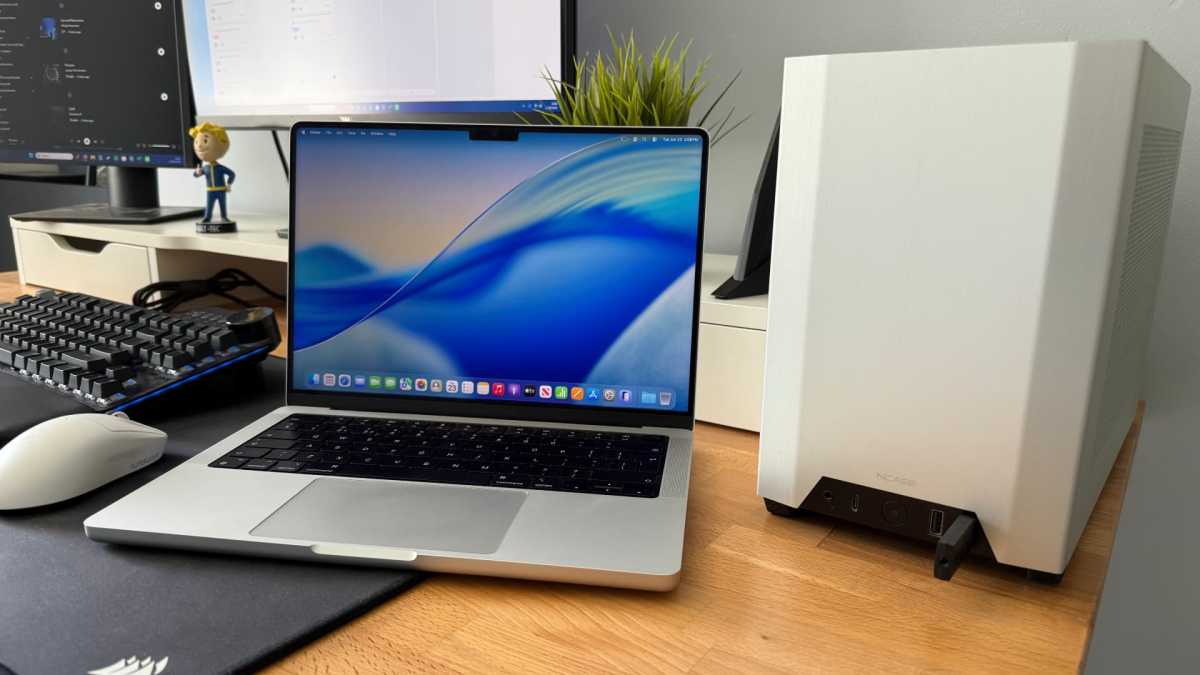
A longtime computer enthusiast maintains both a MacBook Pro and a custom gaming PC to satisfy his gaming needs. The MacBook offers a sleek, portable experience, while the PC delivers the broader game selection necessary for immersive play.
Recent advancements in macOS, including upscaling, ray tracing, and frame generation, have significantly boosted the platform’s gaming performance. Despite these technical strides, the library of high‑profile titles remains sparse compared to Windows.
The open‑world adventureCrimson Desertlaunched on macOS and Windows simultaneously, a rarity that underscores the persistent imbalance in game availability across platforms.

Key franchises such asCall of Duty,Diablo IV, andElden Ringare still missing from the Mac ecosystem. Even earlier releases likeControl Ultimate EditionandDisco Elysiumarrived on Mac years after their Windows debut.
Historically, a chicken‑and‑egg dynamic has kept developers hesitant: few Mac users deter developers, and limited titles deter Mac users. Apple has begun to address this by collaborating with developers to optimize games for macOS and by enhancing hardware capabilities.
The transition to Apple silicon has marked a significant leap in gaming performance, though it still falls short of discrete graphics solutions like Nvidia RTX cards. Integrated technologies such as MetalFX Upscaling and MetalFX Frame Interpolation provide higher resolution output and smoother gameplay without the need for dedicated GPUs.

MetalFX Upscaling increases frame resolution by scaling lower‑resolution frames, thereby conserving resources. MetalFX Frame Interpolation generates additional frames through AI, creating a smoother visual experience comparable to PC frame‑generation technologies.
Performance benchmarks show that achieving 60 frames per second at 720p inCrimson Desertrequires a 2023 M2 Pro chip, whereas a Windows system can reach 1080p at the same frame rate with a 2018 Nvidia RTX 2080. This disparity highlights the cost‑performance gap between the two platforms.
In a comparison using a MacBook Pro equipped with an M5 Max chip, medium settings at 1440p delivered around 60 frames per second with upscaling. A similarly priced Windows PC, running at native 1440p on maximum settings, achieved a higher frame rate of approximately 50 frames per second, while a lower‑spec PC could reach about 110 frames per second on medium settings with upscaling.

Higher costs coupled with lower performance on Mac discourage developers from launching titles on the platform, perpetuating the cycle of limited game availability.
To reverse this trend, the platform must incentivize developers to release games on day one and continue advancing hardware and software performance year over year. Achieving parity in cost and performance with Windows systems is essential for broader adoption.
Increasing visibility through strategic partnerships with gaming brands could raise the platform’s profile, mirroring successful models seen in other media sectors.
While the Mac gaming landscape has improved, it still lags behind Windows. Continued progress may eventually allow users to transition fully to macOS without compromising their gaming experience.


